

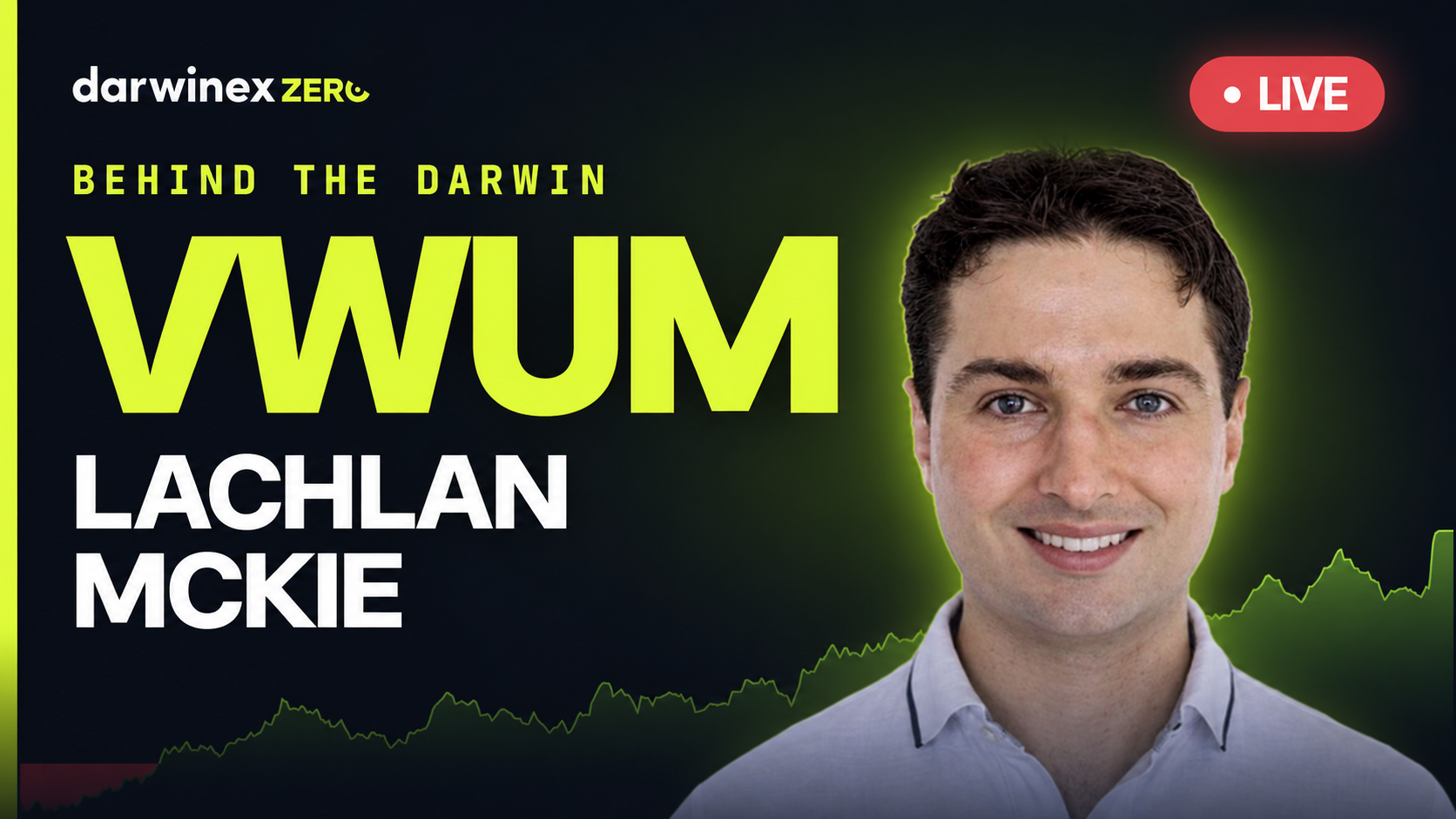
Lachlan McKie runs VWUM, an intraday breakout trend-following portfolio on Darwinex Zero. In the first episode of Behind the DARWIN he explains how he builds systems with machine learning without overfitting, how he handles losing streaks of 20 or more trades, and why he treats a DARWIN as a long game.
Key takeaways
- VWUM is a basket of intraday breakout systems trading US indices, gold and a small amount of FX. Every system closes before the day ends.
- Lachlan backtests on very large samples: a ballpark minimum of 50,000 trades per system.
- Trend following wins 30 to 50% of the time. Expectancy matters more than win rate.
- He does not cut systems on a drawdown figure alone. He looks for a market explanation first.
- His one rule: never let trading turn into gambling.
Watch the full interview on YouTube
Who is Lachlan McKie?
Lachlan is a systematic trader based in Sydney. He has traded CFDs for around seven years. Before that he studied geoscience and worked in Australian gold mining, on both the exploration side and underground production. He has since stepped away to trade full time.
He started like many traders do: manually backtesting stacks of indicators. It took weeks per idea and the results decayed fast once live. Moving to automation changed the pace. A test that took a week by hand ran in a minute or two in FXdreema. Today his main build tool is StrategyQuant X.
How do you use machine learning without overfitting?
StrategyQuant can generate hundreds of thousands of candidate systems in an hour. Lachlan's point is that the speed is the danger. Most of what it produces is fitted to noise. The goal is to find the system most likely to survive new data.
"The principles that I think define success with StrategyQuant are really that of simplicity. And I think the simpler things are kept the better." 14:01
He shortened the learning curve with a course, then ran three to six months of his own research before trusting the process. Sample size is central to it. Intraday systems trade more often, which gives him more evidence per system.
"A lot of the systems that I've launched have in excess of say 30 years of data that have been back tested on, with in excess of, I'd say, a ballpark minimum of 50,000 trades." 18:48
What does VWUM trade?
VWUM is a diversified intraday breakout portfolio. Lachlan picks markets where breakouts have historically paid and costs are low: US indices, gold and a few FX majors. Bitcoin is on his list of markets that suit trend following too. He finds FX the hardest. Commission eats into whatever edge is there. His only FX exposure right now is USDJPY.
Every system trades both directions. On indices he weights them roughly 70% long and 30% short to work with the long-term upward drift without betting everything on it.
How do trend followers handle long losing streaks?
The portfolio averages four and a half to five trades a day. Win rates on trend systems typically sit between 30 and 50%. In February to April 2026 Lachlan saw runs of 20 to 25 losses in a row.
"A back test doesn't really do justice the amount of pain that you can go through as a trend follower." 22:40
His answer is to trust the front-end work and leave the systems alone.
"The second you start tweaking and turning things off, the trend's going to run and you're going to miss it." 24:12
When should you switch a system off?
Lachlan does not use historic or Monte Carlo maximum drawdown as a cut-off on its own. His reasoning: your largest drawdown is always ahead of you. Every system has already breached its old maximum at some point in its history.
Instead he looks for a market explanation. A Nikkei system stagnated for three months while the index chopped around its all-time highs. Volatility in that window was well below its history. He kept it running and it recovered a couple of months later. If he wanted a hard metric, he would compare the system's recent Sortino ratio with its history.
Since mid-2022 he has removed no system for poor performance. He has swapped one or two to lower correlation across the basket.
Why build a track record on Darwinex Zero?
Lachlan found Darwinex while sitting on an airport floor in Brisbane, researching on his laptop. His view of the model is direct:
"It's not a prop firm. It's a legitimate way to build up your own track record and potentially link it up to third party capital down the track if you've got good performance." 43:25
He did not change his approach for the DARWIN. The portfolio was already built for stability. At the time of recording his worst daily loss on VWUM was 1.87%. The Darwinex risk engine has typically applied a risk multiplier of around 0.7 to his signal account. He watches percentage performance, not AuM, and treats every investor dollar as his own.
What's his one rule?
"I'd never let trading turn into gambling." 59:28
Every trade needs a data-backed reason to exist. His reading tip is Ray Dalio's "Holy Grail" video on combining low-correlation return streams to cut drawdown while keeping the upside.
His closing thought for fellow trend followers:
"We pay for the cost of market participation in, I guess, fees and drawdown, and we stay positioned in the markets for when the volatility arrives." 1:13:23
Watch the full interview
There is far more in the hour than fits here, including the full DARWIN review of VWUM. Watch Behind the DARWIN with Lachlan McKie on YouTube and subscribe for new guests every Wednesday.
Building your own track record? Start on Darwinex Zero.
FAQ
What is VWUM?
VWUM is Lachlan McKie's DARWIN on Darwinex Zero. It is a diversified, fully automated intraday breakout trend-following portfolio trading US indices, gold and USDJPY, with every system closing before the day ends.
How many trades should a backtest have?
There is no fixed number, but more is better for separating edge from noise. Lachlan aims for a ballpark minimum of 50,000 trades per system across many years of data, which is one reason he favours intraday systems.
Should you turn off a trading system after a drawdown?
Not on the drawdown number alone. Lachlan first checks whether market conditions explain the drawdown, such as unusually low volatility, and compares recent risk-adjusted metrics like the Sortino ratio against the system's history.
Is Darwinex Zero a prop firm?
No. Darwinex Zero lets traders build a verified track record that can attract investor capital through Darwinex, an FCA-regulated asset manager. There is no challenge to pass.
Thanks for reading,
Darwinex Zero
*Darwinex Zero and the domain www.darwinexzero.com are trade names used by Tradeslide Technologies, a company registered in the United Kingdom under number 14398381.
The contents of this blog post and video are for educational purposes only and should not be construed as financial and/or investment advice.