

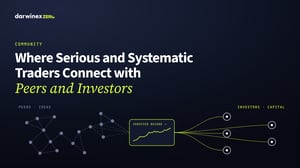
Trading systematically can be a lonely job. You write the rules, test them, run them and live with the drawdowns, usually on your own. Most serious traders eventually look for two kinds of company: peers who can challenge their ideas, and investors who might one day back them. These are different groups, and they tend to gather in different places.
Where do serious traders connect?
Serious and systematic traders tend to connect in four kinds of places: research forums and discussion groups, code-sharing and open-source communities, communities built around a trading platform, and investor-facing venues where performance is on show. Peer communities are best for testing ideas and learning, while investors mostly look for traders through verified, publicly visible track records rather than through chat. So the most useful approach is to learn among peers and let a verifiable record do the talking with investors.
That split matters. A lively group chat can make you a better trader, but it rarely puts you in front of capital. An investor-facing venue can put your results in front of allocators, but it won't debug your position-sizing logic. Knowing which place does which job saves a lot of time.
The four kinds of trader communities, and what each is for
Each type of community has a different strength. The table sums them up; the notes below explain how to use each one well.
|
Type of community |
Best for |
Typical limits |
Who you meet |
|---|---|---|---|
|
Research forums and discussion groups |
Testing ideas, reading critiques of methods, learning statistics and risk |
Claims are mostly self-reported; quality varies by thread |
Other traders, researchers, hobbyists |
|
Code-sharing and open-source communities |
Reviewing code, reusing tools, spotting bugs in backtests |
Little discussion of live performance or capital |
Developers, quants, algo traders |
|
Platform communities (around a broker, data or trading platform) |
Practical help with a specific toolset, live sessions with the team, peers on the same rules |
Conversation centres on one ecosystem |
Traders using the same platform, sometimes staff |
|
Investor-facing venues |
Making a track record visible to people who allocate capital |
Little room for discussion; results speak first |
Investors and allocators, alongside other traders |
Research forums and discussion groups
These are the oldest gathering places for traders. Good ones reward careful questions: how a strategy behaves when volatility doubles, whether a sample is long enough, why a backtest looks too smooth. They are excellent for sharpening thinking. Their weakness is that almost everything posted is self-reported, so a convincing equity curve in a thread proves very little on its own.
Code-sharing and open-source communities
For algorithmic traders, shared repositories and coding forums are often where the real learning happens. Someone else reading your execution logic will spot the look-ahead bias you missed. These communities are about the machinery of trading rather than its results, and they rarely involve investors.
Platform communities
Many trading platforms run their own spaces: chat servers, webinars, Q&A sessions and live streams. Their advantage is focus. Everyone works with the same tools, rules and metrics, so questions get specific answers quickly. With Darwinex Zero, for example, we run a Discord community for members and host regular live sessions on strategy building, market insight and trader performance reviews.
Investor-facing venues
This is where the conversation changes. Instead of discussing ideas, a trader's results are published in a standard format that investors can compare. The key feature is not a chat window but a public, verified track record that someone can study without needing to take the trader's word for anything.
Why investors rarely find traders through chat
Investors and allocators have a filtering problem. There are far more traders who say they are profitable than traders who can show it. Most allocators therefore start from data, not from conversation: they look at standardised, comparable records and only then want to talk.
Consider a hypothetical example. Two traders join the same discussion group. Trader A posts thoughtful analysis every week and screenshots of a strong month. Trader B posts less, but links to a public record covering several years, with every trade, drawdown and quiet period visible. When an investor in the group starts asking questions, Trader B's conversation begins from evidence. Trader A's begins from trust, and the investor has no easy way to check it.
How a verified record changes the conversation
A verified, public track record turns “believe me” into “have a look”. It does a few specific things:
- It removes selective reporting. A record that captures every trade means there is no cherry-picking of the best months.
- It makes comparison possible. When records follow the same format and risk basis, an investor can compare traders like for like.
- It shifts the questions. Instead of “are your results real?”, investors ask about drawdown behaviour, consistency and how the strategy handles different conditions. Those are better conversations to have.
- It travels with you. A link to a public record can be shared in any community, which makes every peer conversation a possible introduction.
Verification is not an audit, though. It confirms that results come from real trading activity recorded by the platform. It does not certify the trader, the strategy or future performance, and investors still do their own due diligence.
How this works with a DARWIN
When you trade with us, your strategy is turned into a DARWIN: an investable index that replicates your trading signals, with its risk managed by our Risk Engine so that DARWINs sit on a comparable risk basis. A DARWIN has its own public page, so investors can study its history while your underlying signals and strategy logic stay private. This is the investor-facing part of our community: the place where your record, not your forum posts, is what people evaluate.
Our DarwinIA programme adds another layer. Each month we rate DARWINs and award notional allocations based on their performance, and the leaderboard is public. DarwinIA allocations are notional and separate from external investor capital, which investors decide to allocate on their own judgement. Neither is guaranteed, and where real capital is involved, it is at risk.
How to choose a community and get real value from it
Not every group deserves your evenings. A few checks help separate useful communities from noisy ones:
- Look at how claims are backed. Communities where members link to verifiable records tend to have better discussions than those built on screenshots.
- Check the tone around losses. Serious groups talk openly about drawdowns and failed ideas. Groups that only celebrate wins teach very little.
- Prefer process over signals. Discussions about method, risk and testing age well. Rooms built around sharing trade calls rarely make anyone a better trader.
- Be wary of guaranteed outcomes. Any group that promises funding, income or a career in exchange for joining deserves caution.
- Match the community to your stage. Early on, research and code communities may help most. Once you have a live record, investor-facing venues become more relevant.
Habits that make you worth connecting with
- Share your process, not just your results. Explain why a rule exists and what would make you change it.
- Ask specific questions. “How do you size positions when two correlated markets signal at once?” gets better answers than “any tips?”.
- Give feedback as well as taking it. Reviewing someone else's backtest is one of the fastest ways to improve your own.
- Keep your record public and continuous. A long, unbroken history is more persuasive than any single strong period, to peers and investors alike.
FAQ
What are the best communities for systematic and algo traders? The most useful mix is usually a research forum for ideas, a code-sharing community for reviewing your tools, and a platform community where everyone works under the same rules and metrics. Choose groups where members back claims with verifiable records and discuss process openly.
Where do serious traders connect with investors? Mostly through venues where performance is published in a standard, verifiable form. Investors tend to start from comparable track records and reach out afterwards, rather than finding traders through chat rooms.
Do I need a large following to attract investors? No. A following can help visibility, but allocators are generally more interested in a long, consistent, verified record than in audience size.
Is a verified track record the same as an audited one? No. Verification confirms that results come from real trading activity recorded by the platform. It is not an independent audit, and it does not predict future performance.
Does joining a trading community guarantee access to capital? No community can guarantee funding or allocations. A verified record makes your results easier to assess, but investors make their own decisions and any capital allocated is at risk.
Next step
If you want your trading to speak for itself, Darwinex Zero lets you build a verified track record on virtual capital, take part in our DarwinIA programme and join our member community, without putting your own trading capital at risk. See the current membership options on our pricing page.