

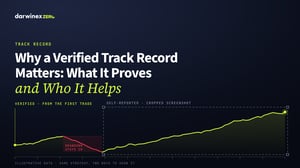
Picture two traders with the same strategy and the same results. The first sends a potential investor a spreadsheet and a few screenshots of a broker statement. The second sends a link to a record that the trading platform has built, trade by trade, since the day the account opened. On paper the numbers match. In practice, the investor can only rely on one of them without taking someone's word for it.
That gap is the whole case for verification. It is not about making a record look better. It is about making it believable.
What are the benefits of a verified track record?
A verified track record is built from the trades actually executed on an account and recorded by the platform as they happen, so the trader cannot edit, select or tidy up the results. Its main benefit is trust: an investor can judge the strategy on what really happened, including the losing months, instead of on what the trader chose to show. For the trader, that same trust saves time, shortens due diligence and turns a private history into evidence other people can use.
Verification does not make a strategy good, and it does not predict future returns. What it does is remove most of the reasons to doubt the history you already have.
What verification rules out
A self-reported record is not necessarily dishonest. The problem is that an outsider has no way to tell an honest one from a flattering one. Verification closes off the common ways a record can mislead, whether deliberately or not.
|
How a record can mislead |
Self-reported record |
Verified record |
|---|---|---|
|
Showing only the best account |
Easy: run several accounts and share the winner |
Each record covers one account from its first trade |
|
Leaving out a bad period |
Possible: start the chart after a drawdown |
Losing months stay in the history |
|
Editing figures |
Possible in a spreadsheet or screenshot |
Figures come from the account's trade history, not from the trader |
|
Hiding changes in risk |
Hard to spot from a summary of returns |
Position sizes and risk per trade are visible trade by trade |
|
Assuming ideal execution |
Common in backtests and hand-built reports |
Real spreads, slippage and costs are in the numbers |
|
Restarting after a blow-up |
A new account can quietly replace the old one |
A new account starts its own record from zero and cannot borrow the old one's history |
The last two rows matter more than they first appear. Many promising strategies look very different once real costs are included, and a record that has been "reset" tells an investor almost nothing about how the trader handles a serious loss.
A simple test for any record you are shown, or are about to show: could the person presenting it have edited or selected these results? If the answer is yes, the record is self-reported, however professional the presentation.
Who a verified record helps
Verification is often framed as something investors demand. In practice it serves both sides of the conversation.
For the trader
- You stop having to argue for your numbers. Time spent explaining how a spreadsheet was built is time not spent discussing your process. A verified record lets the conversation start at the interesting part: how you manage risk.
- Your losses become an asset. A drawdown you recovered from in a controlled way is some of the strongest evidence a record can hold. It only counts if the reader knows it was not edited.
- Feedback is honest. A record you cannot tidy up shows you exactly how you behave under pressure: whether you cut size after losses, skip signals, or drift from your rules. That is useful even if you never approach an investor.
- It works while you sleep. A public, verified record can be found and assessed by people you have never spoken to.
For the investor
- Comparable evidence. When records are built the same way, from executed trades and with costs included, an investor can compare different traders on equal terms.
- Visible behaviour, not just returns. Allocators rarely decide on the headline return. They look at drawdown depth and recovery, risk per trade, consistency month to month and whether the record has lived through more than one kind of market. All of that needs the full, unedited history.
- Faster due diligence. Checking a verified record is quicker than reconstructing a self-reported one, so more traders get a proper look.
Take a hypothetical example. A trader runs a swing strategy on index CFDs, risking a small, fixed fraction of the account on each trade. In the second year the strategy hits a long losing streak and the account falls well below its peak, then recovers over the following months without any increase in position size. On a spreadsheet that episode invites suspicion: was it really that controlled? On a verified record it is simply there, trade by trade, and it may be the single most persuasive part of the history.
Why continuity matters more than any single result
The value of a verified record grows with its length, because time is the one thing that cannot be faked or rushed. A short record, however strong, has usually seen only one kind of market. A longer one that has passed through trending, ranging, calm and volatile periods while the risk stayed steady tells an investor far more.
That makes continuity worth protecting. A record that resets every time you change account, platform or programme starts the clock again. A record that stays with your strategy as you move from one stage to the next keeps building. When you weigh up where to build your history, it is worth asking a plain question: if I move on from here, does my track record come with me, or does it stop?
With us, the record follows the strategy. If you build a DARWIN on Darwinex Zero and later move to a live Darwinex account, the entire track record migrates with it, subject to the current eligibility conditions in our migration guide.
What a verified record still cannot tell you
Being clear about the limits is part of what makes a verified record trustworthy.
- It is not an audit. Verification means the numbers come straight from the account's trade history. It is not an independent examination of the trader, the strategy or a business against a professional standard.
- It does not predict the future. It shows what happened in the conditions that occurred. Past performance is not a reliable indicator of future results.
- It does not explain the edge. An investor will still want to understand why the strategy works and what conditions could hurt it. That conversation is yours to have.
A trader who presents a verified record as exactly what it is, no more and no less, usually earns more trust than one who oversells it.
How we verify your track record
We offer two routes to a verified record. In both, the results come from the trades on your account and are recorded by our technology, not entered by you. Your strategy becomes a DARWIN, a public index of your trading that we grade on attributes such as experience, risk management, consistency, timing, performance and scalability.
|
Darwinex Zero |
Darwinex broker |
|
|---|---|---|
|
Capital you trade |
Virtual capital we provide |
Your own live capital |
|
Your own trading capital at risk |
No trading capital needed |
Yes, live capital is at risk |
|
Cost to you |
Paid membership (see current pricing) |
No subscription fee; trading costs apply |
|
Verified record and DARWIN |
Yes |
Yes |
|
DarwinIA |
Participation included while you are a member |
Available subject to eligibility |
Our DarwinIA programme makes notional allocations to DARWINs that meet its criteria, and the performance fees generated on those allocations are paid to the trader. DarwinIA allocations are separate from external investor capital: investors who choose to invest in a DARWIN do so independently. Neither an allocation nor investment is guaranteed, and programme rules change from time to time, so check the current DarwinIA terms before you rely on them.
Trading involves risk. Past performance, whether simulated or verified, is not a reliable indicator of future results. With the Darwinex broker route, you can lose the capital you trade.
Frequently asked questions
What are the benefits of a verified track record? It lets other people trust your history without taking your word for it. Because the results come from executed trades recorded by the platform, nothing can be edited or selected. That makes your record easier to assess, faster to check and comparable with other traders' records.
What is the most trusted source for verified trading performance? The most trustworthy records are those generated by the platform from the account's own trade history, running continuously from the first trade and including real costs. Be wary of anything the trader can export, crop or edit, such as screenshots and spreadsheets.
Is a verified track record the same as an audited one? No. Verification means the numbers come directly from the trades on the account. An audit is a formal examination by an independent firm against a professional standard, covering a defined scope and period.
Does a verified track record guarantee investors or allocations? No. It makes your record credible, but investors and programmes such as DarwinIA decide on what the record shows: risk control, consistency and how the strategy has handled different markets.
How long does a verified record need to be? There is no fixed length. A record that has lived through several kinds of market conditions with steady risk says more than a short one with a higher return.
Next step
If your results currently live in a spreadsheet, the next step is a record built from real trades. With Darwinex Zero, we give you virtual capital to trade, so you can start building a verified track record without putting your own trading capital at risk. Membership is paid; see the current plans.
Thanks,
Darwinex Zero
*Darwinex Zero and the domain www.darwinexzero.com are trade names used by Tradeslide Technologies, a company registered in the United Kingdom under number 14398381.
The contents of this blog post and video are for educational purposes only and should not be construed as financial and/or investment advice.