
What is a future?
A futures contract is a standardized agreement to buy or sell a specific underlying asset at a predetermined price on a set future date. The underlying asset can be a commodity, a security or any other financial instrument.
In Zero futures contracts, the culmination of a contract occurs at the the expiration date of the contract. This is the moment when the contractual agreement reaches its conclusion, and the exchange of the underlying asset takes place between the two parties involved in the contract, theoretically.
However, in Zero futures trading, as there is no exchange taking place, the close date would be the point in which the position would be closed.
What is the difference between a CFD and a future?
OTC vs regulated exchange
CFDs are financial derivatives traded over-the-counter (OTC), which involves that every broker may provide a different liquidity feed, conditions, and specifications. OTC products are subject to regulatory oversight by financial authorities in the jurisdictions where they are offered.
Futures contracts, on the other hand, are traded on regulated exchanges, such as the Chicago Mercantile Exchange (CME) in our case. These exchanges have specific rules and regulations governing trading activities, including margin requirements, position limits, and trade execution standards.
Contract Standardization
CFD contracts are typically customizable, allowing traders to specify the size and duration of their positions. However, they are not standardized and may vary between different brokers.
Futures contracts are standardized in terms of contract size, expiration date, and delivery specifications.
Leverage and Margin
CFD trading offers up to 30:1 leverage, although this varies depending on the asset class.
Futures trading also involves leverage, but margin requirements are set by the exchange and may be lower compared to CFDs. This can vary depending on the asset class and market conditions.
Unlike CFD margin requirements, futures margin requirements are not a fixed percentage — they are set as a fixed nominal amount per contract. For example, if ZC (Corn) future margin requirement per contract is $1,400, this is the minimum equity you should have to open 1 contract trade, and will be the margin retained at MetaTrader 5. If the nominal value of 1 ZC contract is $22,000, it would mean that actual max. leverage is around 16:1.
In order to calculate the nominal value of any contract, it is needed to multiply the contract size by the current quote of the contract and the price quotation (monetary unit) of that contract.
For example, for the ZC (Corn) contract, the contract size is 5,000. If the current quote is 440 and the price quotation is US cents (0.01), the nominal value per contract is: 5,000 × 440 × 0.01 = $22,000.
This information can be seen here:
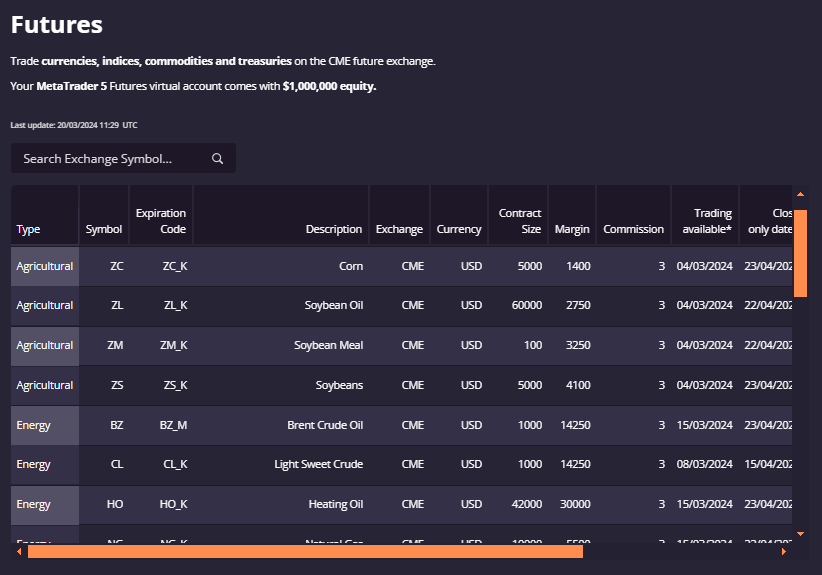
Note: Futures contract specifications, including margin requirements, are defined and subject to change by the CME. Always verify current conditions on the CME website.
Costs
The CFD is a financial derivative instrument with daily expiration. Hence, for maintaining open a trade overnight, there is a swap charge applied. There is an execution commission as well, apart from spreads.
Futures costs include brokerage commissions and exchange fees, which may vary depending on the contract specifications, but there is no swap for keeping trades open from day to the next one.
Specifications
You may check the specifications of each contract in CME (Chicago Mercantile Exchange) website.