
What is it?
Return refers to the financial result associated with an investment decision.
How is it calculated?
Darwinex Zero calculates return as a percentage of the equity used at the start of a given position or timeframe.
The following information is taken into account:
- Closed trades / realized profit or losses
- Open trades / unrealized profit or losses
- Deposits & withdrawals* of money from the account. This is done so the percentage return is reflected correctly.
By calculating return based on equity, deposits and withdrawals do not affect the percentage return. This is done so that a trader can't artificially skew his results by depositing or withdrawing money.
Example
- A trader with €1,000 in their account opens a trade generating a profit of €50 (5%).
- Before closing the position, they decide to withdraw €950.
- Seconds later, they close the trade.
2- Before closing the position he decides to withdraw €950.
3- Seconds later, he closes the trade.
Darwinex splits this trade into 2 positions with the following result:
Position 1 (finishes before the withdrawal of €950):
- Initial equity: €1,000
- Final equity: €1,050
- Return: 5%
Position 2 (starts after the €950 withdrawal and ends when the trade closes):
- Initial equity: €100
- Final equity: €100
- Return: 0%
Compound return of both positions: 5%
Where can I see it?
In Darwinex Zero it is important to distinguish the DARWIN return from that of the signal account.
It is the DARWIN return that is relevant for the DarwinIA seed capital allocations programs and outside investors, since both back the DARWIN and not the underlying signals account.
DARWIN
On My DARWIN page, you can see the return chart for one of the pre-set timeframes offered by Darwinex.
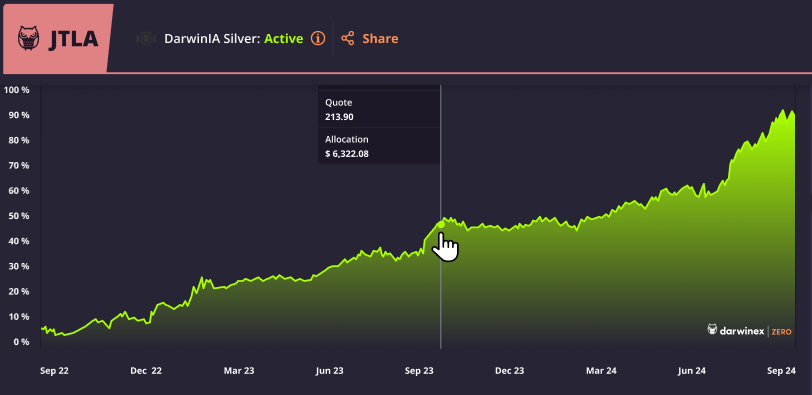
By left-clicking and dragging on the mouse, you can zoom in on a specific period to see the % return for a custom time period.
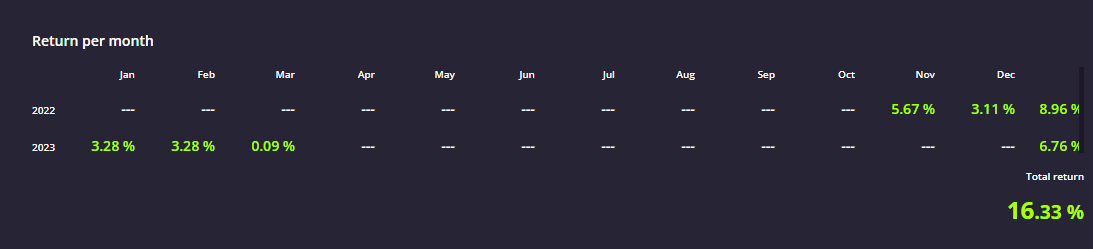
Right below, there is a table showing returns per month, year and since the inception.
Signal account
You can see the signal account performance graph in the "Trading journal" section:

Return calculation formula
Return on summary tables is compounded and not summed. The total cumulative return does not match the sum of the monthly returns.
This is because the cumulative return over a period is calculated by compounding the returns of the constituent sub-periods, and not by simply adding them up, by using the following mathematical formula:
[(1+(R1/100)) * (1+(R2/100)) * (1+(R3/100))* (1+(Rn/100))... -1] * 100
Simply adding the individual period returns is only equivalent to withdrawing all profits at the end of each period — which does not reflect compound growth.