

Every independent trader eventually hits the same ceiling. A strategy can be sound, the risk controls tight and the results steady, yet the money it earns is capped by the size of the account behind it. Doubling your skill does not double your capital. That is why so many traders start asking where outside money comes from, and what it takes to be trusted with it.
There is no single answer, because there is no single route. Each path to outside capital is a different deal: someone else's money in exchange for something from you. That might be a fee, a rulebook, a licence, a share of profits or simply years of evidence. Understanding what each route asks for is more useful than knowing which one sounds most attractive.
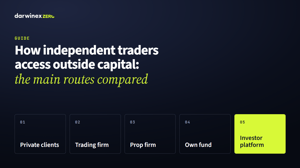
The short answer: independent traders usually access outside capital in one of five ways: managing money for people they know, joining an established trading firm, trading through a proprietary (prop) firm's programme, launching their own fund, or listing a strategy on a platform that connects traders with investors. Every route asks for the same core thing in a different form, which is credible evidence that you can grow capital while controlling risk. The routes differ mainly in whose money it is, what rules you trade under and whether you keep the track record you build.
The main routes to outside capital at a glance
The table below compares the routes on the questions that matter most before you commit time to any of them.
|
Route |
Whose money you trade |
What it expects from you |
Do you keep the track record? |
|---|---|---|---|
|
Friends, family and private clients |
People who know you |
Trust, clear agreements and, in most places, the right regulatory permissions |
Yes, but it is rarely verified by a third party |
|
Joining a trading firm |
The firm's capital |
A hiring process, a CV and often relevant experience or qualifications |
Usually no; results belong to the employer |
|
Prop firm programme |
The firm's capital (sometimes simulated) |
Passing or following the firm's rules on targets, drawdown and conduct |
Usually it stays on the firm's platform |
|
Launching your own fund |
Outside investors |
Legal structure, regulatory approval, service providers and a marketing effort |
Yes, within the fund |
|
Investor and allocation platforms |
Investors on the platform, and in some cases the platform's own allocations |
A consistent, verifiable record under the platform's risk framework |
Usually yes; it is public and portable |
None of these is automatically best. A trader with strong personal connections and a clean legal set-up faces a different choice from a systematic trader with a few years of steady data and no network at all.
Each route, and what it really asks of you
Managing money for people you know
This is often the first route traders think of. A relative or a friend sees your results and offers to put money in. It feels simple, but it rarely is. In many countries, managing other people's money for a fee is a regulated activity, so you may need authorisation or need to work under a firm that has it. Even where the rules allow it, personal capital brings personal pressure. A losing quarter is no longer just a number on a statement.
This route also tends to cap out quickly. The pool of people who know and trust you is small, and their results are rarely verified independently, which makes the record hard to use later with strangers.
Joining an established trading firm
Banks, asset managers and trading firms hire traders to manage their capital. This route gives access to large amounts of capital, infrastructure and mentoring. In return, you give up independence. You trade the firm's mandate, follow its risk limits and usually cannot take your results with you if you leave. Hiring processes tend to favour candidates with relevant degrees, prior industry experience or both, so this route is hardest to enter from a purely self-taught background.
Prop firm programmes
Proprietary trading firms offer traders access to the firm's capital, often after an evaluation phase. Models vary widely. Some ask traders to hit a profit target within set drawdown limits; others offer accounts without a formal challenge but with their own rules. Some trade real capital and others run on simulated accounts. Payouts are typically a share of profits under the firm's terms.
The appeal is speed and a defined process. The trade-off is that you trade under someone else's rulebook, and the record you build usually stays on that firm's platform. If you are weighing this route, read each firm's terms carefully rather than relying on headline figures.
Launching your own fund
Starting a fund gives you the most control and the most direct relationship with investors. It is also the most demanding route. You will typically need a legal structure, regulatory approval, an administrator, an auditor, compliance support and the ability to market the fund to investors. Most investors will still want to see a multi-year track record before committing. For many independent traders, a fund is a destination after proving themselves elsewhere, not a starting point.
Investor and allocation platforms
A growing alternative is to list your strategy on a platform that sits between traders and investors. The platform measures your results, applies its own risk rules and lets investors allocate to your strategy. You typically keep your independence and earn a share of the profits you generate for investors, without having to set up a fund or find investors one by one.
The catch is that these platforms are only as useful as the evidence you give them. Allocations, whether from investors or from the platform itself, follow consistent records. They are earned over time, not handed out.
What every route expects: evidence, risk control and time
Strip away the differences and every source of outside capital is asking three questions.
- Can you prove it? A screenshot of a good month proves little. What carries weight is a record kept by a third party, covering enough trades and enough time to show more than luck.
- How do you lose? Capital providers care at least as much about drawdowns as returns. A strategy that makes steady gains with shallow, quick-to-recover losses is usually more investable than one with a higher return and deep, prolonged drawdowns.
- Has it lasted? Markets move between trending and ranging, calm and volatile. A record that has lived through several of those conditions says more than one that has only seen a single kind of market.
Consider a hypothetical example. Trader A shows a large return over six months, with one losing month that wiped out a third of the account. Trader B shows a modest, steady return over three years, never losing more than a small fraction of capital in any month. Most allocators would look harder at Trader B, because B's record tells them what to expect when conditions change.
Where Darwinex fits: two routes to the same goal
Darwinex is an investor platform of the kind described above. Traders build a DARWIN, an investable index that tracks their strategy. Darwinex applies its own risk-management layer to it, so investors are exposed to a consistent target level of risk rather than to the trader's raw leverage. Investors see the DARWIN's performance, not the underlying open trades, which helps protect the trader's strategy. There are two ways in.
- Darwinex Zero is a paid membership. You trade a virtual account, so you do not deposit or risk your own trading capital, while building a verified track record. After an initial period of activity, a DARWIN is created from your trading. Eligible DARWINs can receive notional seed allocations through the DarwinIA programme, which pays the trader a performance fee on the returns those allocations generate. Strong DARWINs can also be opened to investors. See the Darwinex Zero pricing page for current membership terms.
- The Darwinex broker is for traders ready to trade their own live capital. There is no subscription fee, and DarwinIA participation is available subject to eligibility. Trading costs apply and your live capital is at risk. Traders with an existing history can migrate an eligible MetaTrader track record or an Interactive Brokers account rather than starting from zero.
It helps to keep two things separate. DarwinIA allocations are notional and come from Darwinex's own programme. External investor capital comes from third-party investors who choose to invest in a DARWIN. Both depend on the track record, and neither is guaranteed. Performance fees are paid on a high-water mark basis, so a trader is only paid on new profits. Past performance is not a reliable guide to future results, and investors' capital is at risk.
How to choose the right route for you
A few honest questions narrow the field quickly.
- Do you have a verifiable record yet? If not, your first job is building one. Every route gets easier once you have it.
- How much independence do you want? Employment and prop programmes trade independence for structure. Funds and investor platforms keep you in charge of your own strategy.
- Do you want to keep what you build? A record that stays on someone else's platform may not help you later. A public, portable record keeps working for you.
- What can you take on legally and practically? Managing private money or running a fund brings regulatory duties. Platforms that handle the investor side can remove much of that work.
- Are you prepared to risk your own capital? If not, look for routes that let you build a record without a live deposit.
Many traders combine routes over a career. They might build a record without risking their own capital, move to live trading once the strategy has proven itself, and later attract investors to it.
Frequently asked questions
How do independent traders raise capital to manage? Most raise it through private clients, employment at a trading firm, prop firm programmes, their own fund, or investor platforms that connect traders with investors. In every case, a consistent, verifiable track record with controlled drawdowns is what unlocks the capital.
How do traders get allocated capital from investors? Investors allocate to traders whose results they can check and whose risk they understand. On an investor platform, that usually means building a public record the platform measures, then meeting its risk and consistency criteria. Allocation is never guaranteed, however good the record.
What is the best way for a trader to access investor capital? It depends on your situation. If you lack a network or want to stay independent, a platform that verifies your record and connects you with investors avoids the cost of setting up a fund. If you want structure and a salary, employment may suit you better.
Do I need a licence to manage other people's money? In many jurisdictions, managing money for others in return for a fee is regulated, and doing so without authorisation can be unlawful. Rules vary by country, so check with your local regulator or a qualified adviser before taking anyone's money.
Is a prop firm account the same as investor capital? No. A prop firm gives you access to its own capital (or a simulated account) under its rules. Investor capital comes from third parties who choose to back your strategy. The two models reward different things, and the record you build may or may not be yours to keep.
Next step
If you do not yet have a verified track record, Darwinex Zero lets you build one on virtual capital, without depositing trading capital, and work towards capital allocation opportunities. Membership is paid; see the pricing page for current terms. Allocations are not guaranteed.
Thanks for reading,
Darwinex Zero.
*Darwinex Zero and the domain www.darwinexzero.com are trade names used by Tradeslide Technologies, a company registered in the United Kingdom under number 14398381. The contents of this article are for educational purposes only and should not be construed as financial and/or investment advice.