

Picture a backtest with a smooth equity curve, a high win rate and barely a dip in ten years of data. To the trader who built it, it looks like proof. To an experienced investor, it looks like a question: how many versions were tried before this one, and what happens when real orders meet a real market?
That gap explains why so many strategies that impress on screen never attract capital. Investors are not sceptical of backtesting itself. They are sceptical of evidence that the trader could have shaped, consciously or not, after seeing the result.
The short answer: to prove a trading strategy works, show investors a track record built from real-time decisions that you could not edit after the fact, ideally recorded by an independent platform rather than reported by you. It should run long enough to cover different market conditions, keep risk consistent from month to month and include every cost. A backtest can explain your idea, but only a live or forward-tested record shows that it survives contact with the market.
The rest of this guide explains why backtests fall short, how investors rank different kinds of evidence and what you can do to build a record that holds up.
Why investors discount backtests
A backtest answers one question: how would these rules have performed on this historical data? That is useful for developing an idea. It is weak evidence that the idea will work going forward, for four common reasons.
1. Overfitting. With enough parameters and enough attempts, almost any rule set can be tuned to fit past prices. Each tweak that improves the historical result also risks fitting noise rather than a repeatable edge. Investors know a published backtest is usually the best of many trials, and they mentally discount it for every version that was tested and discarded.
2. Regime change. Markets move between trending and ranging phases, calm and volatile periods, and different interest-rate and liquidity environments. A strategy tuned on one kind of market can fail quietly when conditions shift. A backtest that covers only one regime, however long, tells an investor little about the next one.
3. Slippage and costs. Backtests often assume fills at the price on the chart. Live trading adds spreads that widen at the worst moments, partial fills, commissions, financing charges and the delay between signal and execution. For high-frequency or short-term strategies, these frictions can turn a profitable backtest into a losing live system.
4. Hidden data problems. Look-ahead bias (using information that was not available at the time), survivorship bias (testing only on instruments that still exist) and errors in historical data all flatter results. None of them is visible to an investor reading a summary.
The common thread is that a backtest is produced after the data is known. Live results are produced before. That single difference is why investors weigh them so differently.
The evidence ladder: how investors rank proof
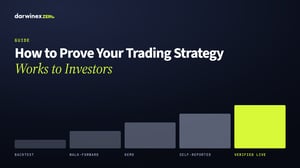
Not all evidence carries the same weight. Think of it as a ladder: each rung removes another way the result could have been shaped after the fact.
|
Evidence |
What it shows |
How investors tend to weigh it |
|---|---|---|
|
In-sample backtest |
The rules fit the data they were built on |
Explains the idea; little weight as proof |
|
Out-of-sample or walk-forward test |
The rules held up on data held back during development |
Better, but the trader still controls the test |
|
Demo or paper trading |
The strategy can be run in real time |
Shows discipline; execution is often idealised |
|
Self-reported live results |
Real trades, as presented by the trader |
Easy to cherry-pick accounts or periods |
|
Live or forward record on an independent platform |
Real-time decisions recorded as they happen, with costs and nothing removed |
The strongest common evidence a trader can offer |
Most traders try to persuade investors from the bottom two rungs. The most effective thing you can do is climb to the top one and stay there long enough for the record to mean something.
A note on wording: a platform-verified record confirms that the trades happened as shown. It is not the same as an independent audit of your accounts, and you should not describe it as one.
What a convincing track record contains
Climbing the ladder is necessary, but not sufficient. A live record can still fail to persuade if it is short, erratic or hard to interpret. The records that hold up tend to share six qualities.
- Enough time and variety. A few strong months prove very little. Investors want to see the strategy through several different market conditions, including at least one stretch that did not suit it.
- Consistent risk. If position sizes swell after losses or shrink after wins, the return figure stops meaning much. Steady risk per trade and per month shows the result came from the process, not from a lucky bet.
- Honest drawdowns. Every real strategy has losing periods. What matters is whether drawdowns stayed within the range you would expect and how the strategy behaved while recovering.
- A match between story and behaviour. If you describe a slow trend-following system, the record should not show dozens of short-term trades a day. Consistency between your stated process and your actual trades builds trust.
- All costs included. Results net of spreads, commissions and financing are the only ones that matter to someone allocating real money.
- A complete, unedited history. One continuous account, with nothing deleted or restarted, carries far more weight than a selection of good accounts or periods.
A simple hypothetical shows why. Trader A shows a record with a higher total return built mostly on two oversized trades. Trader B shows a lower return, but with similar risk every month and drawdowns that recovered in a measured way. Most allocators would study Trader B first, because B's result is more likely to repeat.
Tools and habits that prove consistency
No single tool proves a strategy works. What you need is a combination that records your decisions in real time and makes your consistency easy to see.
- Write the process down before you trade it. A short document setting out your markets, entry logic, risk per trade and maximum acceptable drawdown gives investors something to check your record against.
- Keep a separate account for the strategy. Mixing strategies, or discretionary trades with systematic ones, makes the record impossible to read.
- Use a platform that records trades independently. Broker statements and third-party track-record platforms capture trades as they happen, so the history is not something you compile yourself.
- Track risk-adjusted metrics over rolling windows. Rolling figures for volatility, drawdown and return per unit of risk show whether performance is stable, not just positive.
- Keep a trade journal. Notes on why you took or skipped trades help you explain the record when an investor asks about a specific period.
- Resist resetting. The temptation to start a fresh account after a bad run is strong. Every restart weakens the record you are trying to build.
These habits cost little and compound over time. A trader who has run one documented strategy in one account for several years is in a much stronger position than one with a dozen short, impressive-looking accounts.
Where Darwinex fits
Darwinex offers two routes to the top rung of the ladder, depending on whether you want to trade your own money.
Darwinex Zero is a paid membership that lets you build a verified track record on virtual trading capital, so no trading capital of your own is needed. Your trading is turned into a DARWIN: an investable index that follows your timing and asset selection while an independent risk engine scales its risk to a common target level. Because every DARWIN runs at comparable risk, investors can compare strategies on a like-for-like basis. The DARWIN's quote starts at 100 at inception, includes trading costs and does not disclose your individual trades, which protects your strategy.
The Darwinex broker is for traders ready to trade their own live capital. There is no subscription fee, trading costs apply and live capital is at risk. Live accounts can also become DARWINs, and existing MetaTrader or Interactive Brokers history can be brought across to form a historical record. DarwinIA participation is available subject to eligibility. DarwinIA allocations are separate from any capital that outside investors may choose to put into a DARWIN.
On either route, a strong record improves your case but does not guarantee an allocation or investor capital. Membership details and current terms are on the official Darwinex Zero pricing page.
Frequently asked questions
How do I prove my trading strategy works to investors? Show a live or forward-tested track record recorded by an independent platform, run over long enough to include different market conditions. Keep risk consistent, include every cost and never edit or restart the history. Use your backtest to explain the idea, not as the proof.
Are backtests enough to attract investors? Rarely. Investors know backtests can be overfitted and often ignore slippage, costs and changing market regimes. A backtest supports your explanation of the strategy, but most investors want to see real-time results before committing capital.
What are the best tools to prove trading consistency? A combination works best: a dedicated account for each strategy, a platform that records trades independently, rolling risk-adjusted metrics such as volatility and drawdown, and a trade journal. The aim is a record that you could not have shaped after the fact.
How long should a track record be before showing investors? There is no fixed minimum. A useful test is whether the record covers more than one kind of market, including a period that did not suit the strategy. Longer records with steady risk are generally more persuasive than short, spectacular ones.
Is a verified track record the same as an audited one? No. Verification confirms that the trades and results shown were recorded as they happened on the platform. An audit is a separate, formal review by an independent firm.
Next step
If you want to start building investor-grade evidence without putting your own capital at risk, a Darwinex Zero membership lets you build a verified track record on virtual capital, with your strategy turned into a risk-standardised DARWIN. If you are ready to trade your own money, the Darwinex broker route has no subscription fee; trading costs apply and your capital is at risk.
Thanks for reading,
Darwinex Zero
*Darwinex Zero and the domain www.darwinexzero.com are trade names used by Tradeslide Technologies, a company registered in the United Kingdom under number 14398381. The contents of this article are for educational purposes only and should not be construed as financial and/or investment advice.