

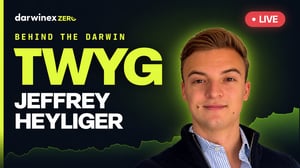
Jeffrey Heyliger runs TWYG, an algorithmic portfolio of breakout strategies on Darwinex Zero. In episode four of Behind the DARWIN he tells Blayn how an account blown during the pandemic pushed him into automation, and he walks through his process. He starts from a borrowed base idea, strips it back to the entry and tests it across dozens of markets before any parameter gets optimised.
Key takeaways
- Jeffrey starts from existing base strategies and strips out every filter until only the entry is left.
- A multicurrency test comes first. Only symbols showing a profit factor of around 1.15 or better get tested individually.
- He tests in a fixed order: entry timing, then stop and target, then filters.
- To avoid curve fitting, he picks values from the middle of a working range, never the single best result.
- If a strategy breaches its historical maximum drawdown plus 20%, it moves to demo until it shows it can recover.
Watch the full interview:
Who is the trader behind TWYG?
Jeffrey is 25 and lives in the Netherlands. He found trading at 16 or 17 through a YouTube video that bought after green candles and sold after red ones. He followed it with a supply and demand method he learned in a trading community, which is where he and Blayn first met.
Manual trading never fitted around school. He couldn't take a setup in the middle of an exam or on a train with no signal. Then he bought an algorithm that turned out to be a martingale. When the pandemic hit, it blew his account while he was on holiday with no access to his VPS. Within a few weeks he was learning to build algorithms properly.
"If I pursue this way of algorithmic trading, I'm fully in control. I know what I'm doing." 7:11
It took him around two more years to become consistently profitable.
Where do his strategy ideas come from?
Other people's work, tested properly. He sees no point building from a blank page when base strategies are freely shared.
"You don't have to reinvent the wheel yourself." 18:29
His first step is to remove whatever filters the original author added, because he wants to check they actually help. What's left is the entry. He runs that across FX majors and minors, gold, crypto and indices with a few ATR-based stops, then picks out the symbols with a profit factor of roughly 1.15 or better.
Each of those gets its own structured test. Entry timing comes first, then stop loss and take profit, then filters. He builds in FXdreema and backtests in MetaTrader 5 on high-quality tick data with spreads and commissions included. He uses the broker he trades live with wherever he can.
How does he avoid curve fitting?
He picks from the middle of a stable range. If an ATR multiplier is tested from 1 to 2 in steps of 0.1, he looks for a block of neighbouring values that all work and takes the one in the centre.
"You know that a set of values is working and then you pick the best one that sits right in the middle." 1:06:04
If only one setting works and the values around it swing between good and bad, he treats the result as noise. He learned the opposite lesson early on, when adding complexity made backtests look perfect.
"You can make any strategy look like it's the holy grail in your backtest, but it can completely destroy your account live." 16:10
Why breakouts?
They're where he finds edges most easily. Mean reversion has given him a few acceptable backtests and nothing he'd run live. Two breakout systems on gold is his limit, because a third would push correlation and combined drawdown too high. He diversifies by moving into new markets instead: crypto and indices have given him strategies with low or even negative correlation to the FX book.
Most of what he builds never goes live. He cites Jim Simons on the hunt for subtle anomalies.
"If they're easy to find, everyone will find them and it does not work anymore." 54:38
What happens when a strategy goes into drawdown?
Nothing, as long as it stays inside its tested limits. Early on he would close winning trades by hand after a losing streak. He no longer does.
"We have to keep running the strategies and not touch anything. So that gives a lot of rest for me." 41:04
His exit rule is set in advance. A strategy can go 20% beyond its historical maximum drawdown. Past that, it comes off the live account and runs on demo. If it recovers and its profit factor and return-to-drawdown still hold up, he retests it and may bring it back.
Why start a track record on Darwinex Zero?
Jeffrey opened TWYG in November 2025 and wishes he'd done it sooner. He trades every strategy on his own capital first, risking half a percent per trade on his master account. His advice is to keep a clean trading account. A tidy history with consistent risk can be imported to give a new track record a head start. His own was too messy to use.
"Everything that runs on Darwinex runs on my personal money as well, on my private capital." 34:07
Watch the full interview
The full episode includes the live review of TWYG, chat questions on AI and discretionary strategies, and Jeffrey's question for next week's guest. Watch Behind the DARWIN with Jeffrey Heyliger on YouTube and join the Darwinex Zero Discord to put your questions to the next guest.
Building your own track record? Start on Darwinex Zero.
FAQ
What is TWYG?
TWYG is Jeffrey Heyliger's DARWIN on Darwinex Zero. It is an algorithmic portfolio built mainly from breakout strategies, developed in FXdreema and tested in MetaTrader 5, with every strategy also running on his own capital.
How do you avoid curve fitting when optimising a strategy?
Look for a range of neighbouring parameter values that all perform well, then pick one from the middle. A single standout value surrounded by poor results is usually fitted to noise and is unlikely to hold up live.
When should you turn off a trading strategy?
Set the rule before you go live. Jeffrey allows 20% beyond the historical maximum drawdown, then moves the strategy to demo and only reconsiders it if it recovers and its core statistics still hold.
Is Darwinex Zero a prop firm?
No. Darwinex Zero lets traders build a verified track record that can attract investor capital through Darwinex, an FCA-regulated asset manager. There is no challenge to pass.
Thanks for reading,
Darwinex Zero.
*Darwinex Zero and the domain www.darwinexzero.com are trade names used by Tradeslide Technologies, a company registered in the United Kingdom under number 14398381.
The contents of this blog post and video are for educational purposes only and should not be construed as financial and/or investment advice