

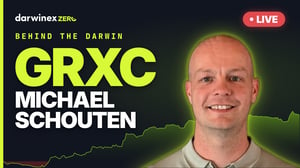
Michael Schouten is a Dutch algorithmic trader who runs GRXC on Darwinex Zero, a four-strategy portfolio built mostly on intraday breakouts. On Behind the DARWIN he tells Blayn how a career in professional football and 11 years running a driving school shaped his discipline, how he stress tests every backtest, and why he plans for drawdowns before he plans for profits.
Key takeaways
- Michael played professional football from age 10 to 21 and ran a driving school for 11 years before trading full time from January 2026.
- Every parameter he picks needs profitable neighbours, and he takes the middle value, never the best one.
- His own analysis tool removes the five best trades from a backtest and reruns it, to see whether a few outliers are carrying the result.
- He runs four strategies so he always knows his worst day: all four losing at once.
- Hitting the backtest's maximum drawdown triggers a review. He makes that decision himself, not an AI.
Watch the full interview:
Who is the trader behind GRXC?
Michael is 34 and from the Netherlands. He spent his youth at Sparta Rotterdam as a professional footballer, then joined his parents' driving school. He has no background in finance or economics and taught himself to trade.
Manual trading never worked for him. He bought courses, chased returns that were far too high and took trades in the evening that he didn't believe in, because he couldn't trade during lessons. An advert for algorithmic trading changed that. His first algorithm was a martingale and grid system, which he describes as stressful and a poor fit for the Darwinex risk engine. Around two years ago he started building his own strategies in FXdreema. Today he builds most of them with Claude.
How did football and teaching help his trading?
Blayn put it to him that both careers taught discipline and patience. Michael agreed. As a young player he learned to handle injuries, being dropped and pressure on match day. As an instructor he learned to break a task down into steps.
He found the move from manual to algorithmic trading easy for the same reason. Rules replace feelings.
"And there's no space for your feelings." 13:24
His view is that discipline and handling stress are what keep a trader in the game, so they don't quit after a 5% drawdown two or three months in.
How does he stress test a backtest?
His process is standard in outline and strict in practice. He uses in-sample and out-of-sample testing and Monte Carlo analysis. He also checks each parameter's neighbours: with a 1% stop loss, settings of 0.8% and 1.2% must be profitable too.
"I will not pick the best one but I prefer to pick the middle one from the parameters, so you have a lot of space if the market doesn't do what you want." 22:34
He has also built an analysis tool that strips the five best trades out of a backtest and runs it again. Breakout strategies often rely on a handful of very large winners. If removing them breaks the result, he doesn't trust the strategy. Anything that passes then goes through around a month of incubation before it reaches GRXC.
Very few make it. Only 1 to 2% of what he builds passes his filters. He now has two AI agents building and testing strategies around the clock, and after three weeks none had passed.
What happens when a strategy hits its maximum drawdown?
It gets reviewed. Michael doesn't switch it off automatically. He treats the maximum drawdown from the backtest as his line. Anything shallower is normal behaviour, even if it hurts. If a strategy with a 12% backtest drawdown is 8% down live, it is doing what he tested it to do.
He is building a tool that compares live results with each backtest and alerts him when a strategy reaches its maximum drawdown or longest losing run. The decision that follows stays with him.
"Those are the decisions I want to make myself and not an AI like Claude or something else." 36:05
How does he stay grounded after a big month?
The same way he handles drawdowns: by knowing his average. A month far above his backtest's normal range is celebrated briefly, then treated as an outlier.
"And I think being too happy with some profits is really dangerous." 44:50
How many strategies should you run?
For Michael, between four and eight. He runs four now, mostly intraday breakouts on volatile markets, and is adding longer-term trend following for diversification. He avoids mean reversion systems without a stop loss because the downside is too open for him to sleep well.
Keeping it small means he knows his worst case. All four strategies losing on the same day is the most he can lose, and it has never happened. He adds strategies one at a time, both to judge each one and to avoid confusing the risk engine.
What is his advice for new traders?
Start with the downside. Most traders ask how much they can make. Michael asks how much drawdown he can handle, then sets risk to match.
"The hardest thing in algo trading is not taking the profits, is taking the losses." 1:00:53
He suggests running new strategies on a demo account first and imagining the backtest's maximum drawdown happening live. If that feels uncomfortable, reduce risk before you start. The book that shaped his thinking is Best Loser Wins by Tom Hougaard.
Watch the full session
The full episode includes the GRXC record on screen and Michael's question for the next guest. Watch Behind the DARWIN with Michael Schouten on YouTube and join the Darwinex Zero Discord to put your questions to him.
Building your own track record? Start on Darwinex Zero.
FAQ
How do you stress test a trading backtest?
Run in-sample and out-of-sample tests, then Monte Carlo analysis. Check that settings either side of your chosen parameters are also profitable. Michael Schouten also removes the five best trades and reruns the test, to see whether a few large winners are carrying the result.
Should you remove the best trades from a backtest?
As a check, yes. Breakout strategies in particular can depend on a handful of very large wins. If the backtest still holds up without its five best trades, the edge is less likely to rest on luck or a few rare market moves.
When should you turn off a trading strategy?
Set the line before you go live. Michael uses the maximum drawdown from the backtest. Anything shallower is normal behaviour. If the live drawdown passes it, he reviews and retests the strategy before deciding whether to keep it.
Is Darwinex Zero a prop firm?
No. Darwinex Zero lets traders build a verified track record that can attract investor capital through Darwinex, an FCA-regulated asset manager. There is no challenge to pass.
Thanks for reading,
Darwinex Zero.
*Darwinex Zero and the domain www.darwinexzero.com are trade names used by Tradeslide Technologies, a company registered in the United Kingdom under number 14398381.
The contents of this blog post and video are for educational purposes only and should not be construed as financial and/or investment advice