

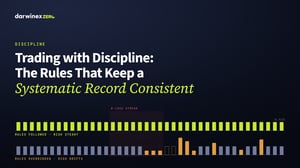
Picture two traders running exactly the same system. Same entries, same exits, same risk per trade. Then the system hits a losing streak, as every system eventually does. One trader keeps following the rules. The other starts to "help" the system: smaller size here, a skipped signal there, a wider stop on the trade that just has to come back.
Months later, their returns might even look similar. Their track records won't. One shows a strategy. The other shows a person arguing with a strategy, and a careful reader can tell.
What trading discipline means for a systematic trader
Trading discipline means applying your rules the same way after losses as after wins. In a track record, it shows up as steady risk, consistent position sizing and exits that follow a recognisable pattern. The platforms that suit disciplined, consistent traders are the ones that verify a live record and measure that behaviour, not only the headline return.
Returns alone can hide a lot. A trader who doubles their size to recover a drawdown can still end in profit, yet the record shows risk spiking exactly when it should have been steady. To anyone deciding whether to back a strategy, that is a warning sign.
Two hypothetical traders, one system
Let's make the scenario concrete. The figures below are invented for illustration only.
Ana and Ben each run the same rules-based trend system. The rules risk 1% of the account per trade, use a fixed stop and exit on a trailing signal. The system's history suggests that a run of seven or eight losing trades is normal and will happen from time to time.
Then it happens. Eight losses in a row.
Ana keeps taking every signal at 1% risk. The drawdown is uncomfortable, but it sits inside what the system's history said to expect. When the trend returns, the next winners recover most of the loss.
Ben reacts in stages:
- After the fifth loss, he halves his risk to 0.5% "until it settles down".
- After the seventh, he skips two signals because "the market looks choppy". One of them would have been the first big winner.
- Frustrated at missing it, he takes the next signal at 2% risk to catch up.
- When that trade moves against him, he widens the stop instead of accepting the loss.
On paper, Ben hasn't changed his system. In practice, he has replaced it with an untested one, run on mood.
How rule drift shows up in a track record
Each of Ben's interventions felt small. In a properly analysed record, they're anything but. Here is what typically gives rule drift away:
- Unstable risk. Risk per trade swings between half and double the usual level, so the record's volatility no longer reflects the strategy.
- Exits without a pattern. Losing trades are closed at very different levels: some at the stop, some far beyond it.
- Losses held longer than gains. Widening a stop while taking winners quickly creates an asymmetry that is easy to measure.
- Missing trades. Skipped signals break the link between the strategy's logic and its live results, which makes the backtest less useful as evidence.
- Behaviour that changes with the drawdown. Decisions made after losses look different from decisions made after wins.
At Darwinex, we analyse this kind of behaviour directly. Every DARWIN, the investable index built from a trader's strategy, is scored on a set of investable attributes. Several of them are about consistency rather than return:
|
Attribute |
What it looks at |
How rule drift can affect it |
|---|---|---|
|
Risk Stability |
How stable the strategy's risk has been over time |
Changing size after losses makes risk unstable |
|
Risk Adjustment |
How often our Risk Engine has to step in to rein in excess risk |
Sizing up to recover a drawdown can trigger more intervention |
|
Loss Aversion |
Whether losing and winning positions are treated symmetrically |
Holding losers while cutting winners early lowers the score |
|
Negative Return Consistency |
Whether losing trades are closed in an identifiable pattern |
Moving stops breaks the pattern |
|
Duration Consistency |
Whether positions are closed in an identifiable pattern by how long they have been open |
Discretionary early or late exits blur it |
Why investors weigh consistency over one good run
Someone allocating to a strategy isn't buying its past return. They're buying the behaviour that produced it, in the hope that the behaviour continues. A record full of overrides tells them that the real decision-maker is the trader's reaction to stress, and that is very hard to forecast.
Consistency also makes a record comparable. We apply a common risk target to DARWINs through our Risk Engine, so different strategies can be judged on a like-for-like basis. A strategy whose own risk keeps changing fits that framework less cleanly, and the gap between the trader's account and the DARWIN becomes harder to interpret.
Consistency is also what gives a long record its value: years of the same rules through different market conditions say far more than a strategy quietly rewritten every time it struggled.
Pre-commitment rules that keep a record consistent
The most reliable way to avoid Ben's path is to decide, while you're calm, what you will do when things go wrong:
- Fix risk per trade in writing. Choose a level the strategy can live with through its worst expected streak, and don't change it in response to recent results.
- Set your expected losing streak and drawdown before you go live. Use the strategy's history, or a simple simulation, to estimate what "normal bad" looks like. If a streak sits inside that range, it isn't a reason to intervene.
- Define a pause rule, not an override rule. If you need a circuit breaker, make it mechanical: for example, stop trading entirely once a pre-set drawdown is reached and review before restarting. Pausing is a rule; half-trading is drift.
- Never move a stop away from the market. Stops can be tightened by the rules. They are never widened because a trade "should" come back.
- Change the system only through a change process. Make changes between trading periods, test them out of sample, record what changed and why, and treat the result as a new version.
- Automate execution where you can. An Expert Advisor or other automated execution removes the moment where you decide whether to take the signal.
- Keep a decision log. Note any trade you didn't take as the rules required. If the log fills up, revisit the rules or the risk level.
What to look for in a platform as a disciplined trader
If consistency is your edge, choose somewhere that can see it:
- Verified results recorded as you trade. Records built from trades placed through the platform in real time carry more weight than uploaded statements or backtests.
- Behavioural analysis, not just returns. Look for metrics on risk stability, exits and loss handling, so disciplined behaviour is visible.
- Comparable risk. Some form of risk normalisation makes it fairer to compare strategies that trade at different sizes.
- A record you keep building. Consistency is proven over years, so the record should be able to grow with you.
- A route from record to capital. Being judged on behaviour is most useful when it can lead somewhere.
This is the problem we built Darwinex Zero to solve. With a Darwinex Zero membership, you trade virtual capital, so no trading capital of your own is at stake. Your strategy becomes a DARWIN with a verified track record, scored on its investable attributes and monitored by our Risk Engine. Our analytics show your risk-adjusted metrics, drawdown patterns and historic asset allocation, so you can spot drift in your own trading before an investor does. Through our DarwinIA programme, DARWINs compete on merit for notional allocations, and leading DARWINs can go on to access investor capital. None of that is guaranteed: it depends on how your strategy performs over time.
If you're ready to trade your own live capital, the Darwinex broker route has no subscription fee and DarwinIA participation is available subject to eligibility. Trading costs apply and, on a live account, your capital is at risk.
FAQ
What does trading discipline mean for an algorithmic trader?
It means letting the system run as designed: taking every signal at the planned size and changing the rules only through a deliberate, tested process. The most common failure isn't a coding error. It's a human overriding the code after a run of losses.
What are the best platforms for disciplined, consistent traders?
Look for platforms that verify results as you trade and analyse behaviour as well as returns, such as how stable your risk is and how you handle losing trades. On Darwinex Zero, we score each DARWIN on investable attributes that include Risk Stability and Loss Aversion, so consistency is visible to investors.
Which algo trading platforms offer track record verification?
Options range from third-party sites that track a linked broker account to platforms that build the record from trades placed on their own infrastructure. Check whether the record is built as you trade, whether it can be selectively shown, and whether it measures risk behaviour. Verification confirms what was traded; it isn't an independent audit.
Should I ever override my trading system?
Pausing under a pre-set rule is reasonable. Changing size, skipping signals or moving stops mid-drawdown is not, because it replaces a tested strategy with an untested one. If you keep wanting to override, review the rules or risk level between trading periods instead.
Does a losing streak mean my system has stopped working?
Not necessarily. If the streak and drawdown sit inside what the strategy's history suggests is normal, they're part of the system. A streak well outside that range is a reason to pause and review under your change process, not to improvise.
Next step
If you want a record that shows your discipline as clearly as your returns, start building it with a Darwinex Zero membership. See our current pricing and path to capital for the current terms.